
Product case study · validation in progress

Whiff

The permanent home for a private sports group.

Across competitions, sports, and seasons.

Aim. Pick. Talk about it.

Visit Whiff Web launched September 2, 2026
Role
Sole creator
Status
Active product · validation in progress
Scope
Product strategy · Brand and UX · Full-stack engineering
Platforms
Web · iOS/Android
Timeframe
August 16 → September 2, 2026 launch

01 · Problem

The group lasts.
The tooling doesn’t.

Private sports pools are social products held together by operational tools. The competition may live in a spreadsheet, the conversation in a group text, and the history nowhere at all. Every new season asks the commissioner to rebuild the same community.

Whiff began with a narrower question: what if college-football Pick’em and Survivor could be the entry point to a durable home for the group itself?

02 · Product thesis

One durable community.
Many reasons to return.

The competition gets people in. The accumulated relationships, rituals, rivalries, and history give them a reason to stay.

  1. IdentityUser
  2. Durable homePool
  3. Repeatable runCompetition
  4. Game windowSlate
  5. DecisionPick
  6. HistoryResult / Event

Pool is the product’s center of gravity: one identity, roster, role system, chat, invite code, history, and trophy cabinet. Competitions repeat inside it by sport, season, and format.

03 · Pivotal decisions

Three choices shaped the product.

Each decision resolves a tension in the product and leaves behind concrete, shipped proof.

One user-facing pool, two durable layers

Keep the architecture. Simplify the noun.

Tension
An earlier product model exposed both a permanent group and a season-format pool, duplicating homes, rosters, chats, join codes, and settings.
Choice
Preserve the two-level data model but expose one user-facing Pool containing repeatable Competitions.
Shipped proof
One home, roster, join code, chat, and creation flow across web and mobile—with concurrent competitions and reproducible eligibility underneath.
Social by default, private by design

Conversation stays open. Picks stay closed.

Tension
Picks create conversation, but exposing another member’s selection before lock breaks trust and competitive integrity.
Choice
Keep activity contextual, enforce reveal-at-lock on the server, and let only a member deliberately publish their own pick sheet.
Shipped proof
A server-owned state transition reveals group picks only after the slate locks; self-sharing remains an explicit member action.

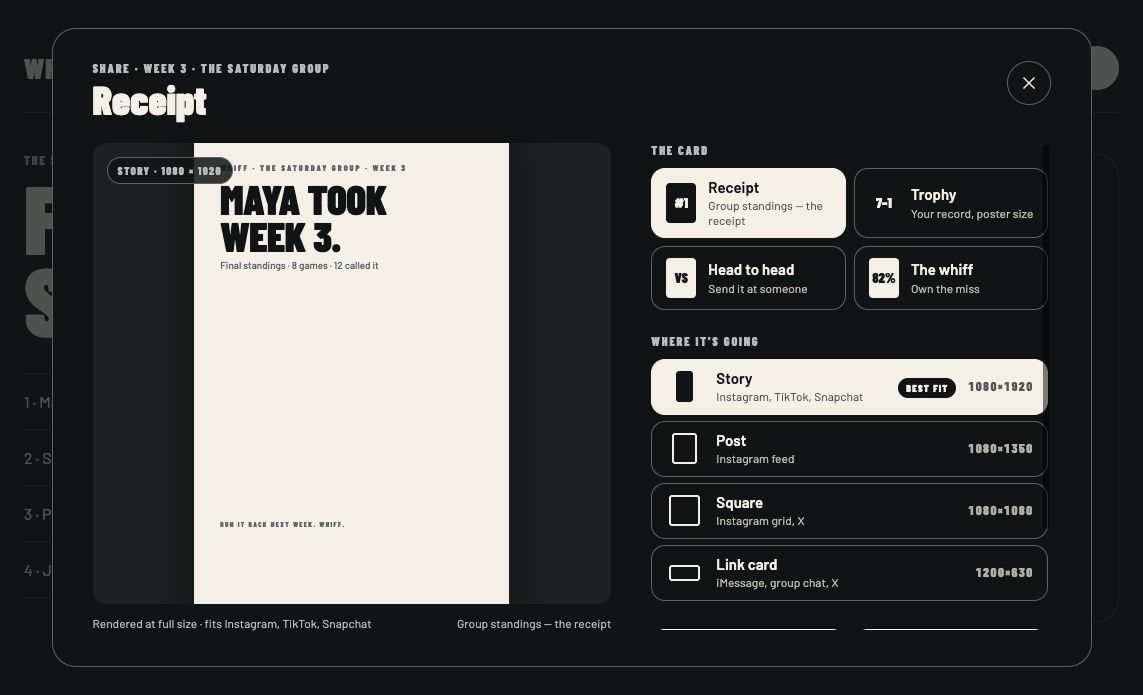
Private competition, shareable stories

Turn the outcome into the invitation.

Tension
The product is intentionally private, but group energy and acquisition happen in external group chats and social channels.
Choice
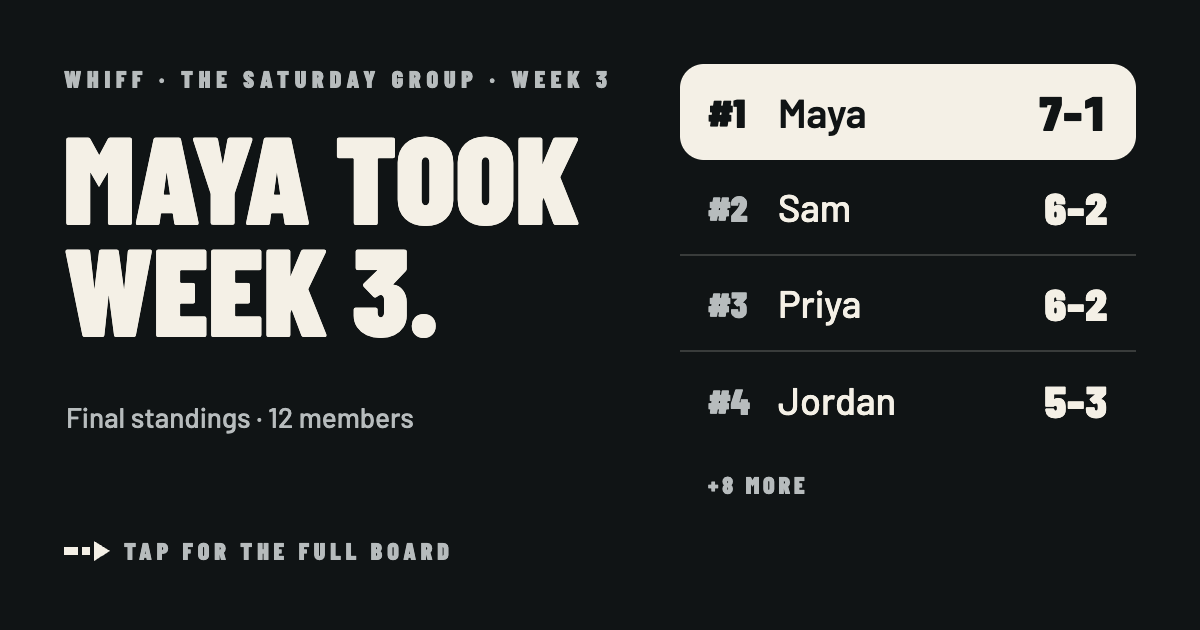
Turn outcomes into native Story, Post, Square, and Link compositions, with static and animated variants.
Shipped proof
A completed share-sheet and card pipeline turns standings into channel-ready assets without making the pool public.
Whiff share-sheet design reference showing receipt-card and social format selection
Design reference · the share sheet makes format and destination explicit.
Synthetic Whiff link card showing a week-three group standings result
Synthetic fixture · a finished result becomes a group-chat-ready story.

04 · Evidence and status

Engineering shipped.
Behavior still has to answer.

Site visits
5,680
Users
68
Active pools
3
Formats live
CFB Survivor · CFB Pick’em · NFL Survivor

Shipped engineering

  • Unified Pool/Competition model across web and mobile
  • Brand and UI/UX standards pass
  • Static and animated share-card system
  • Real-time updates with reconnect, backfill, resnapshot, and polling fallback
  • Deterministic fixtures and aggregate release checks

Still being validated

  • Invite acceptance and participation quality across live pools
  • On-time picking after closed slates
  • Week-over-week operation without developer scoring intervention
  • Apple App Store readiness and longer-term user outcomes

The most important design move was separating the product’s mental model from its storage model. Engineering could retain the two layers needed for history and concurrent competitions while the interface returned to one object people already understood: their pool. The next questions are behavioral, not architectural, and require live-pool evidence.